Dentures are removable teeth that rest on your gums. Dental implants are small posts placed in the jawbone that hold teeth firmly in place. Dentures cost less upfront and need no surgery. Implants feel and work more like natural teeth and help slow the bone loss that follows tooth loss. The right choice depends on your bone, your health, your budget and the life you want back.
Most people who search “dentures vs implants” aren’t comparing brochures. They’re tired of a denture that slips when they laugh. Of cutting steak into tiny pieces, or skipping it. Of keeping adhesive in the car, the office and the nightstand. Of the moment at a family dinner when they stop talking because something feels loose.
This guide compares both options honestly, including where dentures are the sensible choice, so you can decide with clear eyes.
Dentures vs implants: the quick comparison
| Removable dentures | Teeth fixed on implants | |
|---|---|---|
| What it is | A plate of teeth that sits on the gums, held by suction or adhesive | Posts in the jawbone that hold a crown, a bridge or a full arch of teeth |
| Surgery | None | Yes, usually under anesthesia |
| Stays in place | Can move when you eat, talk or laugh | Fixed teeth don’t come out; snap-in overdentures click onto implants |
| Eating | Hard and chewy foods are often difficult | Closer to natural teeth for most foods |
| Your jawbone | Keeps shrinking under the denture | Implants help preserve the bone around them |
| Upkeep | Relines every 1–2 years, replacement around every 7–10 years | Daily cleaning and regular checkups; teeth on top may need repairs over the years |
| Upfront cost | Lower | Higher |
| Long-term cost | Adds up with relines, adhesives and replacements | Mostly upfront, plus maintenance |
The lifespan and reline figures for dentures come from the Cleveland Clinic. Your own numbers will depend on your mouth and your habits.
How each option works
Dentures
A full denture replaces a whole arch of teeth with acrylic teeth set on a gum-colored base. The upper denture usually covers the roof of your mouth to create suction. The lower one has less to hold onto, which is why lower dentures are often the most frustrating. Partial dentures clip onto remaining teeth. You take dentures out to clean them and, usually, to sleep. The MedlinePlus guide to dentures is a good neutral overview.
Implant-supported teeth
An implant is a titanium (sometimes zirconia) post placed in the jawbone. Once it bonds with the bone, it can hold:
- A single crown, for one missing tooth.
- A bridge, for several missing teeth in a row.
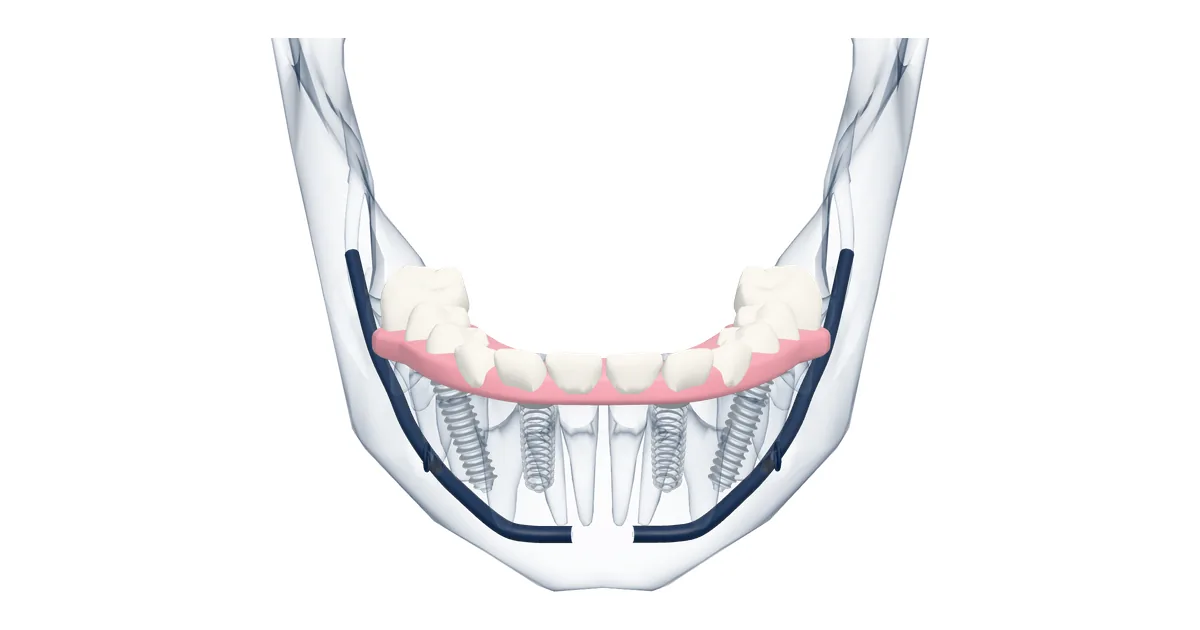
- A snap-in overdenture: a denture that clicks onto two or more implants. It still comes out for cleaning, but it doesn’t float. Our page on implant dentures explains how they work.
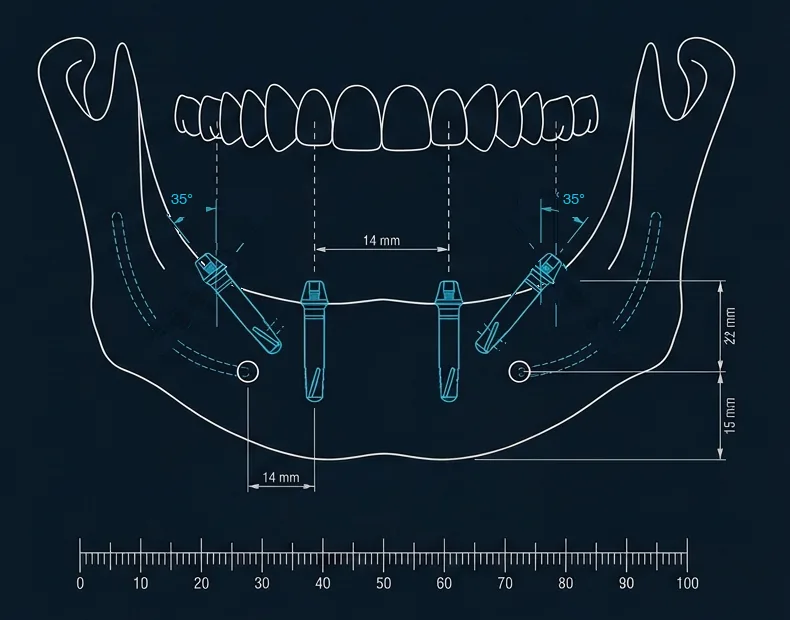
- A fixed full arch: a complete set of teeth screwed onto four to six implants, such as All-on-4 dental implants. You don’t take it out at night.
The American Academy of Periodontology describes implants as an alternative for people currently wearing bridges or removable dentures.
Eating, speaking and confidence: the part brochures skip
Here is what denture wearers most often say they miss, and it’s rarely about looks:
- Biting into food again. An apple, corn on the cob, a good steak. With a loose denture, many people quietly change what they eat.
- Tasting food. An upper denture covers the palate. Fixed teeth on implants usually leave it open.
- Talking without thinking about it. Clicking, whistling and the fear of a denture dropping at the wrong moment.
- Laughing with your whole face. Not covering your mouth in photos.
The research backs up what patients feel. Two expert consensus statements, from McGill (2002) and York (2009), concluded that for a lower jaw with no teeth, a denture held by two implants should be the minimum standard of care, because patient satisfaction and quality of life are significantly higher than with a conventional denture (Thomason et al., 2012).
That doesn’t mean everyone needs a full set of fixed teeth. It means that even a modest step, from a floating denture to one anchored by implants, can change daily life.
What happens to your jawbone over time
This is the difference most people never hear about until it becomes a problem.
When a tooth is lost, the bone that held it starts to shrink. A systematic review of human studies found that within six months of an extraction, the jaw ridge lost 29–63% of its width and 11–22% of its height, with the fastest loss in the first three to six months (Tan et al., 2012).
A denture rests on top of the gums, so it doesn’t stop that process. As the bone keeps shrinking, the denture fits less well, which is why relines become routine and why a denture that fit perfectly ten years ago may barely stay in today. Implants work differently: like natural tooth roots, they load the bone, and the Cleveland Clinic notes they help halt the bone loss that follows tooth loss.
If you want to understand this better, read how teeth bone loss happens and what it means for your options.
Cost: upfront price vs lifetime cost
Dentures win on upfront cost. That’s real, and for some people it settles the question.
But dentures are not a one-time purchase. Over 20 years, most people pay for several relines, adhesives, repairs and two or three replacement dentures. Implants cost more upfront, and the cost is mostly paid once, plus maintenance and occasional repairs to the teeth on top.
For people in California, the gap between the two narrows when treatment is done in Tijuana. Full-arch implant treatment with us starts from $11,200 per arch for All-on-4, in USD, with a written, itemized quote after we review your scan. To see the full picture, read what dental implants cost in Mexico vs California.
Who is better suited for each option
Dentures may make more sense if you:
- Can’t have surgery for medical reasons, or prefer to avoid it.
- Need a low upfront cost right now.
- Are healing from extractions and need temporary teeth.
- Are comfortable with your current denture and simply want a better fit.
Implants may make more sense if you:
- Have a denture that moves, hurts or limits what you eat.
- Want teeth that stay in, day and night.
- Want to slow further bone loss.
- Are healthy enough for oral surgery. Uncontrolled diabetes, smoking and active gum disease can affect healing, as the Cleveland Clinic explains.
“I was told I don’t have enough bone for implants”
This is where many long-time denture wearers get stuck. After years without teeth, the jaw may be too thin for a standard implant, and the answer they hear is “you’ll need a bone graft first” or simply “you’re not a candidate.”
That isn’t always the end of the conversation. Depending on your scan, options can include:
- Angled implants that reach the bone you still have, as in All-on-4 or All-on-6.
- A bone graft to rebuild the jaw before implants.
- Zygomatic implants, anchored in the cheekbone when the upper jaw has very little bone left, often without a graft.
We explain these in detail on our page about dental implants with bone loss. If you’re replacing every tooth in one or both arches, see how full-mouth dental implants are planned by your bone, not by a package.
Questions to ask before you decide
- How much bone do I have, and where? (Ask to see your 3D CT scan.)
- Would a snap-in overdenture solve my problem, or do I need fixed teeth?
- Do I need a bone graft, or are there options without one?
- What exactly is included in the quote: scan, temporary teeth, final teeth, follow-ups?
- What happens if an implant doesn’t integrate?
- How often will I need maintenance visits, and who will do them?
Send us your X-rays or CT scan. Our team reviews it and tells you, in writing, which options make sense for your bone.
Frequently asked questions
Are implants better than dentures?
Not for everyone. Implants stay fixed, make eating easier and help preserve jawbone, while dentures cost less upfront and need no surgery. Many denture wearers report higher satisfaction after switching to implant-supported teeth, but your health, bone and budget decide which option fits you. A 3D scan and an honest evaluation come first.
How long do dentures last compared with implants?
According to the Cleveland Clinic, dentures last about seven to ten years on average and usually need a reline every one to two years. Implants are designed as a long-term solution, although the teeth attached to them may need repairs or replacement over time. Regular cleanings and checkups matter for both.
Can I switch from dentures to implants after many years?
Often, yes. Long-time denture wearers frequently have some bone loss, so the evaluation focuses on how much bone remains and where. Depending on your scan, options include angled implants, a bone graft, or zygomatic implants anchored in the cheekbone. A 3D CT scan shows which approach is realistic for you.
Can my current denture be attached to implants?
Sometimes. A denture in good condition can occasionally be converted into a snap-in overdenture that clicks onto two or more implants. In many cases a new denture or a fixed bridge works better. It depends on the fit, the materials and where the implants can be placed, which your dental team checks first.
Is getting implants more painful than getting dentures?
Implant placement is surgery, so it’s done under anesthesia and you shouldn’t feel pain during the procedure. Swelling and soreness for several days afterward are normal and usually managed with prescribed medication. New dentures can also cause sore spots while your gums adjust. Your team should explain recovery in writing before you decide.