All-on-6 Dental Implants: When Six Implants Make Sense
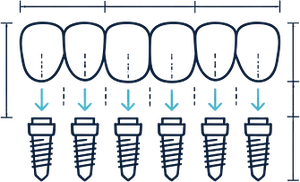
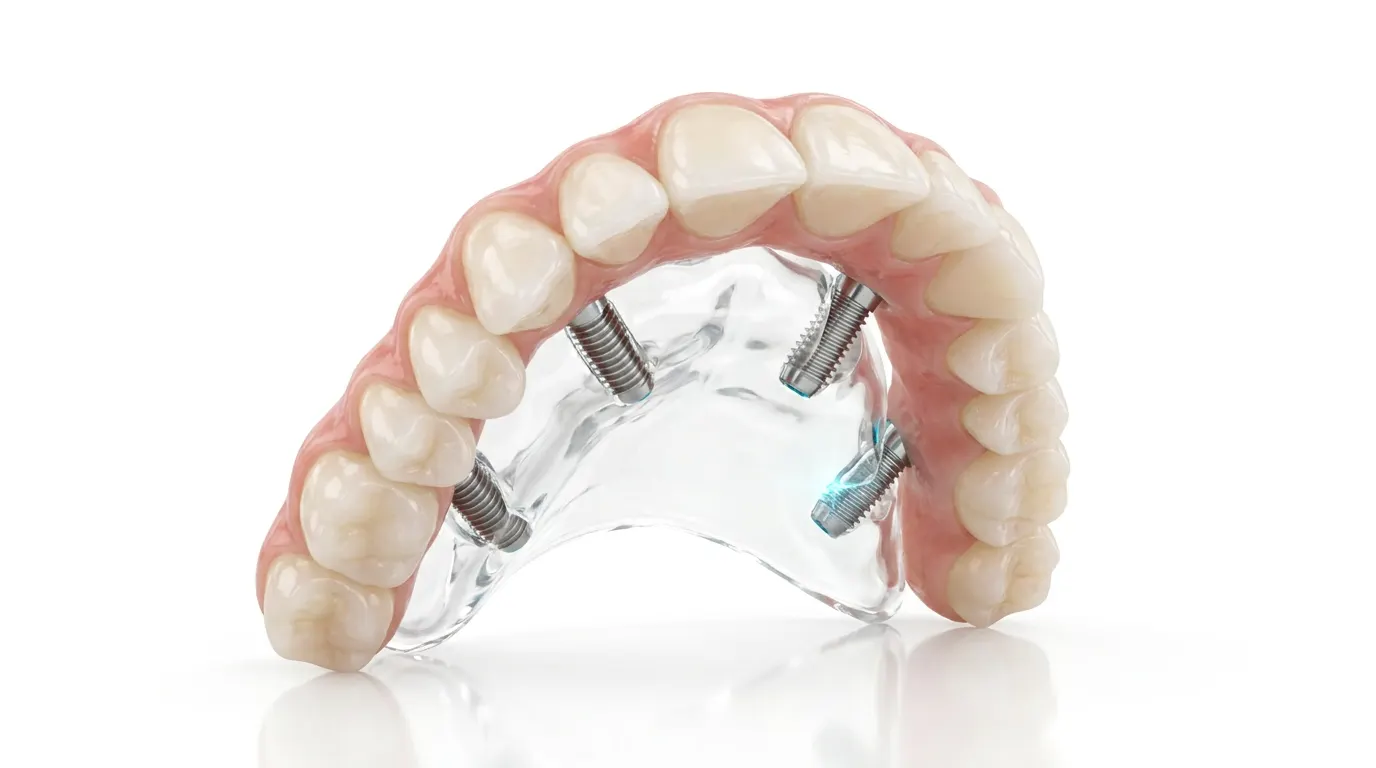
All-on-6 replaces a full arch of teeth with a fixed bridge attached to six dental implants. Compared with All-on-4, the two extra implants spread chewing forces and add a margin of safety, which matters most in the softer bone of the upper jaw and for people who clench or grind.
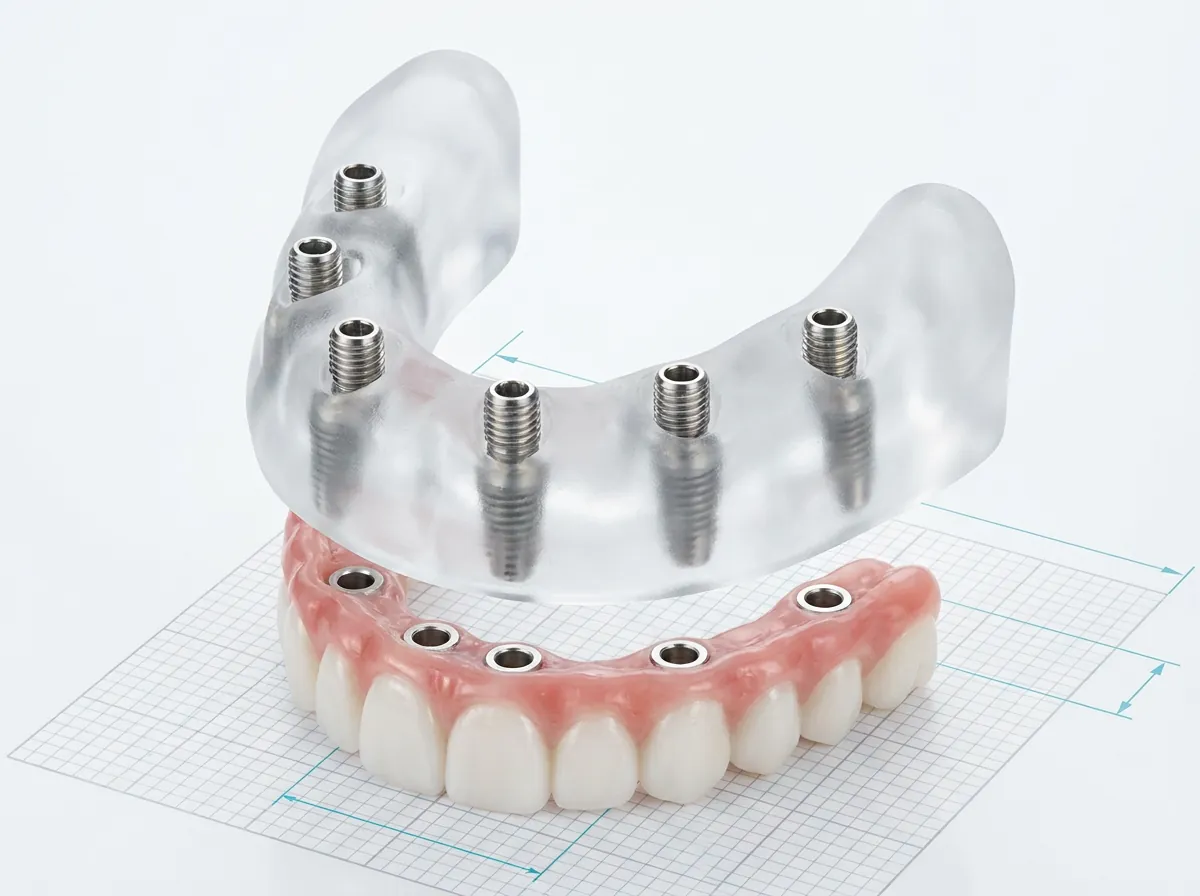
Six is not automatically better than four, and it isn’t a premium upgrade. It is a different engineering choice: more anchors, shorter spans between them, less load on each one. Here is when that trade is worth it, and when four is enough. For the bigger picture, start with full mouth dental implants.
What is All-on-6?
All-on-6 is a fixed full-arch treatment: a bridge of 10 to 14 teeth screwed onto six implants in one jaw. The bridge doesn’t come out at home. You brush it and clean under it like a set of fixed teeth.
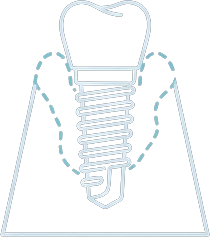
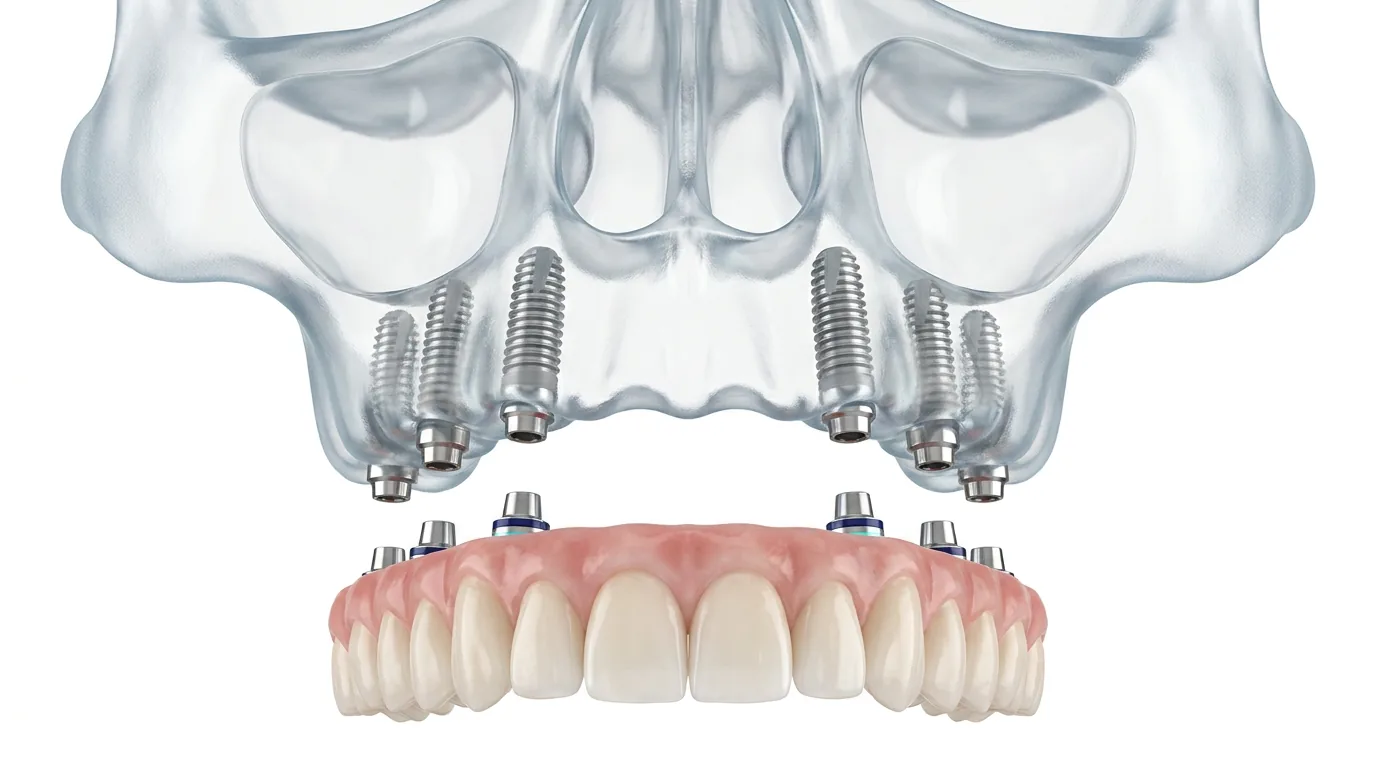
In our 3D planning model of an upper jaw, the six implants measure 13, 13 and 11.5 mm per side, and the back ones keep about 5 mm of bone between their tips and the sinus floor. Your own measurements come from your CBCT scan.
Like All-on-4, a fixed temporary bridge is often attached the same day or within days when the implants are stable enough, and the final bridge follows after healing.

All-on-4 vs All-on-6: what actually changes
A 2024 meta-analysis of upper-jaw full arches (Heliyon, 53 studies (opens in a new tab)) found similar implant survival with four or six implants (98.5% vs 97.0%) but about half the bone loss around six implants (0.46 mm vs 1.02 mm).
Load per implant
Six anchors share the same chewing force. Each implant carries less, and the bridge has shorter unsupported spans.
Bone needed
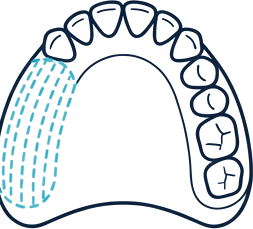
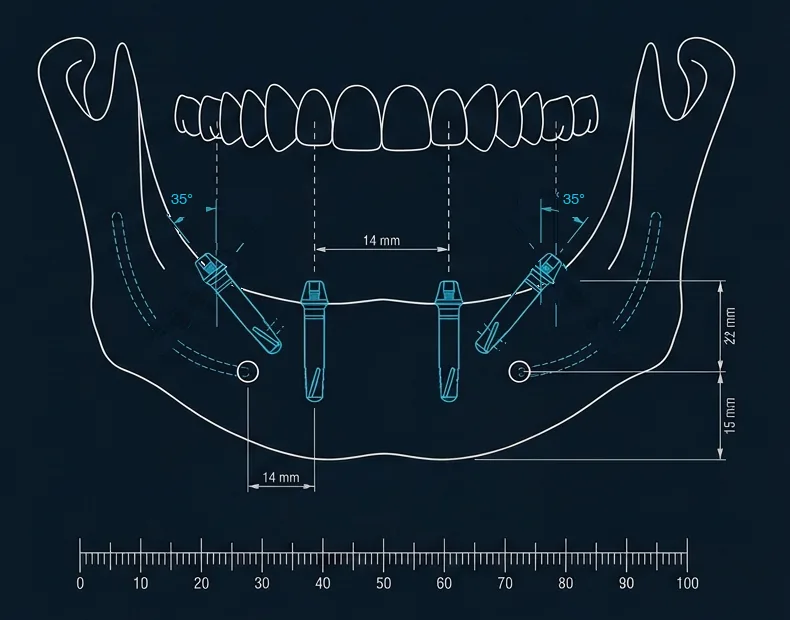
Six implants need bone further back along the arch. All-on-4 tilts the back implants to avoid that need.
Margin if one fails
If one implant out of six has a problem, the bridge often keeps working while it is solved. With four, there is less room.
Cost
Two more implants and abutments. At Implantology, All-on-6 starts at $15,700 per arch, All-on-4 at $11,200.
When six is the better choice
- The upper jaw. Upper bone is usually softer. A long-term All-on-4 cohort found the upper jaw was the most significant risk factor for implant failure (3–17 year cohort (opens in a new tab)).
- You clench or grind. Bruxism multiplies the forces on every implant. More implants share them.
- Soft bone on the scan. When bone density is low, more anchors add stability on day one.
- You want margin. Some people simply prefer the extra safety, and their bone allows it.
And when is four enough? Often in the lower jaw, with good front bone and moderate bite forces. That is covered on All-on-4 dental implants. If the bone is too thin for either, the plan becomes All-on-X dental implants, sometimes with zygomatic implants.
All-on-6 in 3D
Rotate the model to see how six implants sit under the sinus and how the bridge seats on them.
Interactive 3D model for illustration. Your plan is built from your own scan. Anatomy based on Z-Anatomy (CC BY-SA 4.0).

The bridge: titanium-ceramic or zirconia
Our All-on-6 starting price includes a titanium-ceramic bridge: a milled titanium framework with ceramic teeth, strong and repairable. Zirconia is an option for people who want maximum stain and wear resistance.
A 2023 review of zirconia full-arch bridges reported survival of 88% to 100%, with most complications repairable (2023 review (opens in a new tab)). The right material depends on your bite, your habits and your budget, and it is written into your quote.
All-on-6 dental implants cost
Starting prices per arch, compared with published U.S. figures for the same treatment.
| Implantology: starting price | California: published high end | |
|---|---|---|
| All-on-6, one arch, titanium-ceramic bridge | from $15,700 | Up to $60,000 |
| All-on-4, one arch, zirconia bridge | from $11,200 | Up to $60,000 |
| 3D CT scan | $120 | Up to $879 (U.S. range) |
Implantology: starting price in USD; your written quote depends on your scan, the implant brand and the type of teeth. California: published high end is the highest price each source publishes for that treatment (the U.S. range where no California figure is published). It is not an average and not a quote. Sources, consulted November 20, 2026: SD Oral Surgery, San Diego (opens in a new tab): single implant $3,000–6,000; full arch (All-on-X) $15,000–60,000 per arch; CareCredit, dental X-ray cost, U.S. (opens in a new tab): cone-beam CT $361–879.
Same implant brands used in the U.S. — Nobel Biocare, Straumann, Hiossen — and guided surgery planned on a 3D CBCT.
Includes six implants, six abutments and the bridge listed. Grafts or a sinus lift, if your scan shows you need them, are quoted up front. Full comparison: dental implant cost in Mexico vs California.
The All-on-6 process
Planned from home, two main trips for most people.
- 01

Free evaluation (online).
Send any X-rays or CT scans you already have and a short health history. You get a written answer, not a sales call.
Typically: a reply within 1–2 business days.
- 02

3D CT scan and plan in Tijuana.
The surgeon reviews your bone and explains which option fits and why. You leave with a written, itemized quote.
About 20 miles from downtown San Diego.
- 03

Surgery and temporary teeth.
Implants are placed as planned. When they are stable enough, a fixed temporary bridge goes in the same day or within days.
Typically: one surgical visit.
- 04

Healing, then final teeth.
Bone grows around the implants. Then new scans are taken and your final bridge is made to your face and bite.
Typically: 3–6 months later.

Travel, crossing and recovery: dental implants in Tijuana. Neutral reading before you decide: the FDA’s dental implant guide (opens in a new tab) and Cleveland Clinic on implant-supported dentures (opens in a new tab).
Six implants, one goal
Nobody counts implants at dinner. What people notice is that the bridge doesn’t move, that they can bite into an apple again, and that they stopped thinking about their teeth.
If two extra implants make that more likely for your bone, they are worth it. If they don’t, we’ll tell you.
Send your scan. Get a written answer. No pressure.
Frequently asked questions
What is the difference between All-on-4 and All-on-6?
Both are fixed full-arch bridges. All-on-6 uses six implants instead of four, which spreads chewing forces and adds margin. Studies of the upper jaw show similar implant survival, with less bone loss around six implants. All-on-6 needs more available bone along the arch.
How much do All-on-6 dental implants cost?
At Implantology, All-on-6 starts at $15,700 per arch with a titanium-ceramic bridge. Published California prices for a full arch go up to $60,000 per arch. Your written quote comes after your CT scan.
Is All-on-6 better for the upper jaw?
Often. Upper bone is usually softer, and the upper jaw is a known risk factor for full-arch implant failure. Six implants add support there. Your CBCT scan shows whether there is bone for six.
Can I get teeth the same day with All-on-6?
Often, yes. When the implants are stable enough at surgery, a fixed temporary bridge is attached the same day or within a few days. The final bridge follows after three to six months of healing.
What if I don't have enough bone for six implants?
Then the plan changes: All-on-4 with tilted implants, pterygoid implants at the back of the upper jaw, or zygomatic implants anchored in the cheekbone. That is what All-on-X means.
Is six right for your bone?
Send your scan from home. Dr. Cortés’ team reviews it and answers in writing.
This page is for general information and does not replace a professional evaluation. Every treatment plan depends on an individual clinical examination and imaging. Prices are starting prices in USD and are confirmed in a written quote. Results vary from person to person.