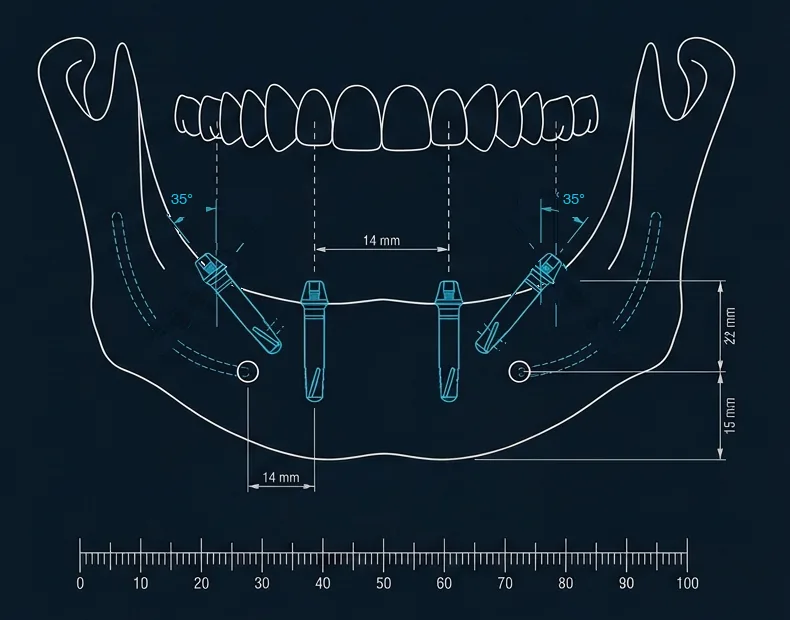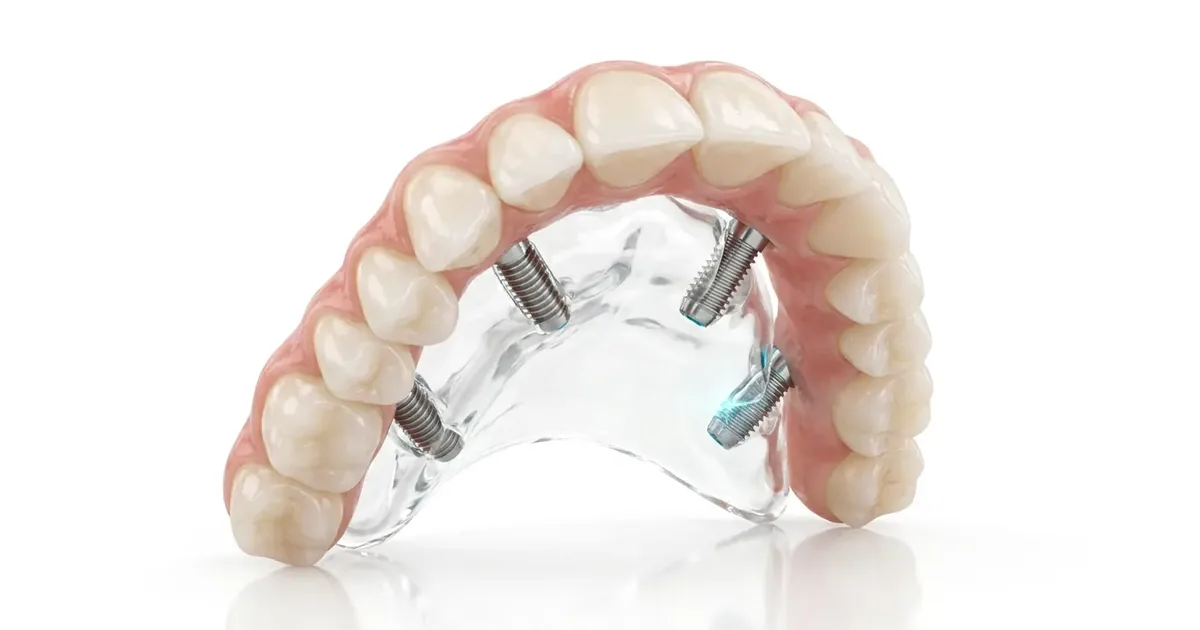
In 2026, one dental implant with its crown is estimated at about $4,500 nationally and about $5,700 in California. A full arch of fixed teeth on four implants commonly runs $15,000 to $38,000 per arch in the U.S., depending on the material. The real number depends on your scan: how much bone you have, how many implants you need, the type of teeth and what the quote actually includes.
If you’ve started asking around, you’ve probably seen prices that don’t match. One office quotes a “starting at” number that sounds reasonable, another sends a total that feels impossible, and neither explains the difference. That’s not you missing something. Implant pricing is genuinely confusing, because an “implant” is really three parts, sometimes several surgeries, and a set of decisions that only a 3D scan can settle.
This guide walks through what each part costs, what’s often left out of a headline price, what insurance does and doesn’t cover, and how to compare quotes line by line, so the number you finally see makes sense.
What you’re paying for: the three parts of an implant
An implant tooth is not one item. When you read a quote, look for each of these:
- The implant. A small titanium or zirconia post placed in the jawbone. It acts as the root.
- The abutment. The connector that joins the implant to the tooth on top.
- The crown, bridge or denture. The part you see and chew with.
Around those three parts sit the services that make them work: the 3D CT scan, the surgery, anesthesia or sedation, temporary teeth while you heal, and follow-up visits. According to the Cleveland Clinic, implant treatment may take a few procedures and several months of healing. Each step can be priced separately, which is why two quotes for “one implant” can be thousands of dollars apart.
What one implant costs in 2026
For a single missing tooth, published 2026 estimates put one implant with its crown at about $4,507 as a national reference and $5,733 in California, with a modeled range of roughly $4,780 to $7,290 in the state (RealDentalCosts, California 2026). Those are editorial estimates, not prices collected from offices, so treat them as a reference point, not a quote.
What moves the price for one tooth:
- Where the tooth is. A front tooth needs careful attention to gum shape and appearance. A molar needs a wider implant and a crown that handles more force.
- Whether you need a bone graft first. A thin or shrunken jaw ridge can add a graft and months of waiting. Published Southern California prices for a graft run about $400 to $3,000 per site (Implant Perio Center). Our guide to bone graft and sinus lift cost explains why.
- The implant brand and the crown material.
- Whether an extraction is included.
If you’re weighing one implant against other ways to fill the gap, read our comparison of a bridge or an implant, which puts the long-term cost of both side by side.
What a full arch costs in 2026
When most or all of the teeth in one jaw are missing or failing, the plan usually changes from “one implant per tooth” to a full arch of fixed teeth held by a few implants.
Published U.S. figures for 2026 (RealDentalCosts, All-on-4 and All-on-6):
| Treatment, per arch | Typical U.S. range |
|---|---|
| All-on-4, acrylic hybrid teeth | $15,000 – $25,000 |
| All-on-4, zirconia teeth | $25,000 – $38,000 |
| All-on-6 | $24,000 – $38,000 |
| Both arches, All-on-4 | $30,000 – $70,000+ |
| One arch with individual implants and crowns | $30,000 – $60,000+ |
| Traditional removable denture | $1,000 – $3,500 |
In California, the average All-on-4 price is about $24,530 based on ADA fee survey data (Hellopearl).
The jump from a removable denture to fixed teeth is large, and it should be. One rests on your gums; the other is anchored in bone. If you’re deciding between the two, our page on All-on-4 dental implants explains how a full arch works and who it fits.
When there isn’t enough bone in the upper jaw for regular implants, some plans use zygomatic implants anchored in the cheekbone. There’s no reliable published average for them in the U.S., because every plan depends on the CT scan. Be wary of anyone who gives you a zygomatic price before seeing yours.
What’s often missing from a headline price
A low “starting at” number isn’t necessarily dishonest, but it rarely describes your case. Ask whether the quote includes:
- The 3D CT scan and the treatment plan.
- Extractions of any remaining teeth.
- Bone grafts or a sinus lift, if needed.
- Sedation or anesthesia.
- Temporary teeth while you heal.
- The final teeth, and their material: acrylic, porcelain or zirconia.
- Follow-up visits and adjustments.
- What happens if something needs to be redone.
A quote that’s thousands lower than every other one often leaves out the final teeth, uses temporary materials as if they were permanent, or prices one arch when you need two. None of that is visible until you put the quotes side by side.
Why the quote changes after the 3D scan
Two people can both “need a full arch” and get very different plans. The difference is in the bone. A 3D CT scan shows how much bone you have, where it is, and where the nerves and sinuses sit. That decides:
- How many implants you need, and where they go.
- Whether you need a graft first, or whether techniques that avoid a graft are possible.
- Whether regular implants are enough or you need advanced options, like those described in our guide to dental implants with bone loss.
That’s why an honest clinic gives you a range before the scan and a written number after it.
Insurance, Medicare and tax-advantaged accounts
Dental insurance. Many PPO plans pay part of implant treatment, but annual maximums are often low compared with the cost of implants. Check the annual maximum, waiting periods for major work and any “missing tooth clause” that excludes teeth lost before you joined the plan.
Medicare. According to Medicare.gov, Medicare doesn’t cover most dental care, including dentures and implants. Some Medicare Advantage plans add dental benefits, so check your own plan’s details.
Medi-Cal. California’s Medicaid program covers many adult dental services, but implants are generally not a covered benefit (RealDentalCosts, California).
HSA and FSA. The IRS counts dental treatment and artificial teeth as medical expenses (IRS Publication 502). Ask your plan administrator how your HSA or FSA applies to your treatment.
Paying over time. Monthly payment plans, healthcare credit cards and dental lenders are common. Read the terms carefully, especially promotional rates that end. We’ll cover dental implant financing in a separate guide.
Is a lower price worth it over time?
Price is what you pay once. Cost is what you pay over the years. According to the Cleveland Clinic, implants can often last a lifetime with good care, while the crowns and bridges on top commonly last around 15 years. A removable denture is cheaper upfront, but it doesn’t stop the jawbone from shrinking, and it needs relines and replacements.
When you compare options, compare what each one costs over 10 or 15 years, not just on the first day.
Crossing the border for treatment: what changes
Many Californians compare their local quote with treatment across the border. Lower prices in Mexico come mostly from lower operating costs, not from different implants, but that only holds if the clinic is careful. Before you decide, read the CDC’s guidance on medical tourism, and make sure you get a written, itemized plan with the implant brand named.
For a line-by-line comparison with published California figures, see what dental implants cost in Mexico vs California. For reference, our starting prices in USD are: one implant with crown from $2,200, All-on-4 from $11,200 per arch (both arches from $22,400), All-on-6 from $15,700 per arch, and a 3D CT scan for $120. Zygomatic plans are quoted only after we see your CT scan.
How to compare two quotes, step by step
- Ask for the plan in writing, with each item priced.
- Check the implant brand and the material of the final teeth.
- Count the implants and the arches. Make sure both quotes describe the same treatment.
- Find the extras: grafts, extractions, sedation, temporary teeth.
- Ask about the timeline: how many visits, and how long until final teeth.
- Ask what happens if something fails, and what that would cost.
- Compare the 10-year cost, not only today’s total.
If you want to see where the money goes at each stage, read the dental implant process, step by step.
The number that matters is yours
A price list can’t tell you what your mouth needs. Behind every implant search there’s usually something more personal: a gap you hide when you smile, a denture that slips at dinner, a quote that felt out of reach. You deserve a clear number, explained in writing, before you decide anything.
Send us your X-rays or CT scan. We'll send back a written plan with every item priced. No pressure.
Frequently asked questions
How much do dental implants cost in 2026?
One implant with its crown is estimated at about $4,500 as a national reference and about $5,700 in California in 2026. A full arch of fixed teeth on four implants commonly runs $15,000 to $38,000 per arch in the U.S., depending on the material. Your price depends on your scan, the number of implants and what the quote includes.
Why do dental implant quotes vary so much?
Because each quote may include different things. One may cover the scan, extractions, grafts, sedation, temporary and final teeth; another may list only the implant. The material of the final teeth and the number of implants also change the total. Compare quotes item by item, not by the headline number.
Does insurance cover dental implants?
Some dental plans pay part of the cost, but annual maximums are often low compared with implant treatment. Medicare doesn’t cover most dental care, including implants, though some Medicare Advantage plans add dental benefits. Medi-Cal generally doesn’t cover implants. Check your plan’s maximum, waiting periods and missing tooth clause.
Can I use my HSA or FSA for dental implants?
The IRS counts dental treatment and artificial teeth as medical expenses in Publication 502. That generally makes implant treatment eligible for HSA and FSA funds, but rules depend on your specific plan. Ask your plan administrator before treatment and keep your itemized receipts.
Is a lower-priced implant worth it?
A lower price can be fair or can hide missing items. Check that the quote names the implant brand, includes the final teeth, and describes the same number of implants and arches as other quotes. Then compare the long-term cost, including maintenance and replacements, not only the first payment.